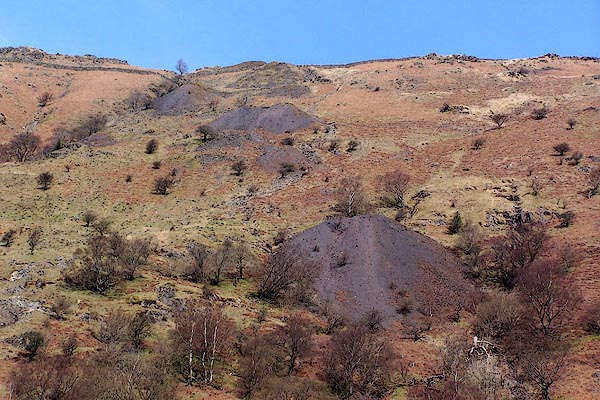
In the fells above Seathwaite, there were deposits of wad (also known as “black-cawke‟, “black- lead‟, “plumbago‟ and “graphite”) mentioned by the historian and topographer William Camden in his tour of the North of England in 1555 and then exploited over the next two centuries until it became a thriving industry in the eighteenth century.
Formed by extreme pressure and heat, it was used, during Queen Elizabeth I’s reign, to make moulds for cannon balls (later its value as pencil lead was exploited). The mineral was very valuable at the time and the mines were protected by armed guards.
In addition, an old copper mine was reopened in nearby Newlands in the 1550’s with the aid of German miners who proceeded o discover quantities of silver and lead as well as copper. These mineral were taken to landing stages on Derwent Water – Nichol End, Copperheap Bay and Brandlewhow – and transported across the lake to the large smelting works at Brigham.
From that time an industrial economy was imposed on Borrowdales farming fabric. Copper was added to the mining mix. Despite security measures, smuggling of wad out of Borrowdale was a regular occurrence in the eighteenth century, as it commanded a high price; thirty shillings a pound in 1779.
Borrowdale remained an isolated valley until a road was built in 1842 connecting it to Keswick, to the North. The graphite was used primarily for dye, pencils and medicine. By 1847, there were 14 pencil factories in Keswick.
More information including a modern day opportunity to experience the mines at:
https://www.glaramara.co.uk/activities/mine-exploration