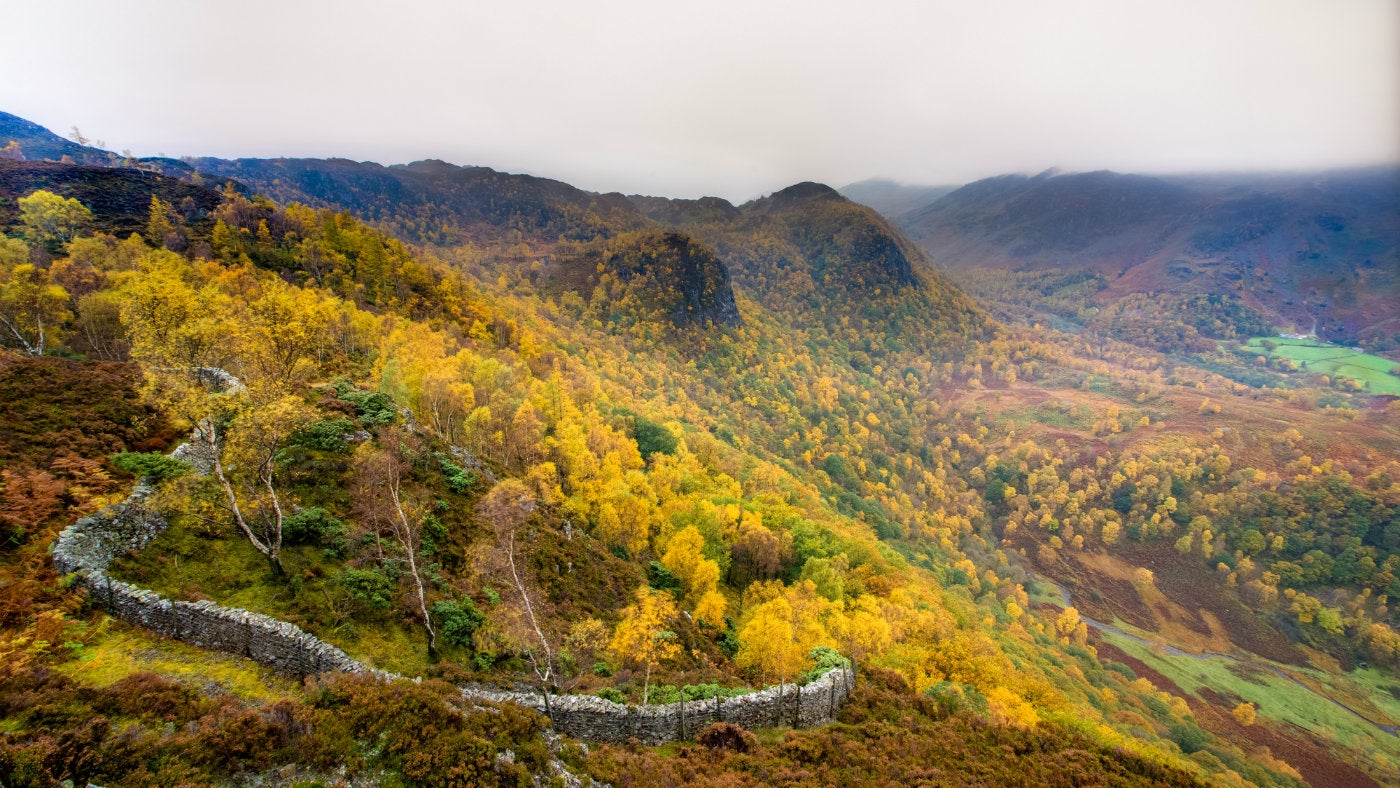
Following on from an earlier post on Borrowdale, here is a little bit more information which may be of interest.
Borrowdale takes its name from the Scandinavian borgardalr, meaning “the valley of the fort‟. The remains of a supposed Romano-British fort lie on the summit of Castle Crag, a well-known viewpoint at the southern end of the gorge. Wainwright recommended it as a climb to take back an enduring memory of the beauty and atmosphere of the district.
Prehistoric occupation within Borrowdale is known to have begun during the Neolithic period, when the valley was thought to be part of an important trade route. The most important evidence for early activity appears in the form of stone quarries and tool manufacturing sites located high in the central fells. There is also evidence of Bronze age cairnfield occupation and funerary sites on the Seathwaite fells. It was anciently called Boredale, and the mountain and its southern extremity is still called Stye Head, and is supposed to be the place where wild boars “were wont to feed in summer, and fall down in autumn into this dale, where they fed upon nuts and acorns”. Many of the Scandinavian place names testify to the arrival of norse speakers into the region after the eighth century.
There little evidence of early medieval activity in the area. The majority of the land of Borrowdale was owned by the monks of Furness Abbey from the 13th century onwards. Much of the dale was purchased from Alice II de Rumelli of Allerdale in 1209, who had, in the closing years of the 12th century, sold parts of Borrowdale – Watendlath (now owned by the National Trust), Langstrath, and Stonethwaite – to another great Cistercian monastery, Fountains Abbey of Yorkshire. Granges (including the modern day village of Grange) were established and the area was used for agriculture and industrial activities such as mining, woodland management, and iron working although the double arched bridge was erected later in around 1675.
During the 14th century, many farms and villages were abandoned because of Scottish raids in 1315, 1322, and 1345.
There are several scheduled monuments and even more listed buildings in Borrowdale many of which are within the current tenancy of the National Trust‟s Borrowdale Farms (including fell land). Some of these date back to these early periods. More details below..